Category Archives: Uncategorized

ETHER ARCHIVES

Wave Form Transmission Art Audio Buffet: “Ether Archives” by Regine Basha and Barbara Held
March 10 at 11:AM EST
Broadcast Archive


In an interview with Regine Basha, we unpack a selection of sonic works and recordings in Barbara Held’s archive and talk about what sonic archives can contain and how they bring communities together both human and non-human, living or living in the ether.
bashaprojects.com

ALETHEIA, UNCONCEALMENT OF BEING 1987
For flute, voice control solenoid system and amplified grand piano by Yasunao Tone

A recording from a 1987 live performance of Yasunao Tone’s Aletheia Unconcealment of Being, is archival on many levels. The performance score consists of dance notations from 8th century China and analytical charts of the dance notations. The interpretation of the flutist is based on the meanings and phonetic values of the Chinese characters used in the score, numbers in the charts and manipulation of the voice control solenoids by parameter of the flute’s amplitude.  The solenoid system was first used for “Piano for Taoists”, with an ancient text, tales of Taoist hermits and magic, in English translation and original Chinese. The voice of the reader triggers electro-magnetic hammers on piano strings so the piano seems to be played by a ghost. 

IMAGEN SONORA DE SIEGA VERDE

Auroch (extinct bull), courtesy of Siega Verde archaeological site

Our conversation in this program includes experiments in archeoacoustics – recordings that I made in the summer of 2025 at a Paleolithic rock art site while enjoying a residency invited by the Campocerrado Foundation. For more information about the rock art at Siega Verde, Villar de la Yegua, Salamanca, Spain:
Siega Verde archaelogical sit

IMAGEN SONORA is a first exploration of the special acoustics at Siega Verde, a site of Paleolithic rock art near Cuidad Rodrigo, Spain, on the banks of the Rio Águeda.

The animals depicted there connect us with a vision of the world that underlines the relationship between human beings and other animals, a link that remains an essential part of this land.

It is believed that one of the possible origins of music came from our relationship with animals—our veneration of them, our kinship, and especially the imitation of their sound rhythms. We also know from ancient sound studies that our ancestors who painted and engraved images on stone were also aware of and explored the power of acoustic reflections and echos of sound, and very likely used certain frequencies to create special meditative states. Maybe they were not so different from us, creating images and sonic spaces that reference philosophy, ritual and science.

Many indigenous people support a life practice of listening and talking directly to nature, thanking the animals and plants, listening to the land with an open heart.

Canadian Anishnaabe philosopher and musician Leanne Betasamosake Simpson writes in her beautiful book Theory of Water, Nishnaabe Maps to the Times Ahead:

“The sound of rushing water is a kind of portal to another world. Places where waves of energy altered human hearing were often where spiritual beings lived or where certain significant events happened. And the sounds in these places, such as that of water moving, were normalized.”

Some researchers call these places “ensouled landscapes”.

I came to the investigation at Siega Verde as an instrumentalist (a flutist) who performs and responds tothe subtleties of spaces and places. More than simply collecting field recordings, I am interested in what curator Regine Basha describes as a sound conversation—an approach of paying close attention to the acoustic properties of the space around me and responding with sound. In turn, the place transmits a reaction to my sounds. At Siega Verde I was able to explore the subtle differences in acoustics that we believe were intentionally nuanced by the artists/shamans who created animal engravings on these immense stone surfaces.

My imperfect recordings document three such locations; a concave stone that filters the sound of the river nearby, a circular space that not only projects sound like a small amphitheater but depicts a flat scene of wolf and auroch (an extinct bull) that from a distance and at a certain angle can be seen in perspective, and a stone with a heartbreakingly simple outline of an auroch’s head and horns on a stone background that creates a totally silent space.

The sound of a place is made up of all the rhythmic phenomena there. To the rhythms of nature such as the sound of the river, birds, depictions of ancient animal rhythms, and a sudden summer rainstorm, I added my own personal rhythm in sound, what composer Dafne Oram called “each human being’s innate waveform”. Barbara Held

Video still, Toni Serra *) abu ali

HEAVEN’S EARTH

A small fragment of my experimental sound compositions for a reading of the archive of sound and moving image by Catalan Artist Toni Serra *) abu ali from his 2019 pilgrimage to Iran, shortly before his death. An image above shows an imense cave, a holy site for prayer and meditation, from Toni’s presence there. My piece is a tribute to the profound musical tradition of Iran, using voices and percussion instruments to activate a convolution reverb made from the real acoustical reverberation of the cave. Toni was a follower of Sufi mysticism, and his recordings of architectural and natural spaces followed the sufi symbol of space as “one of the most direct symbols of Being. It is primordial, all-pervading, and in the cosmology of Islam, the “locus” of the Universal Soul”.
Toni Serra *) abu ali https://al-barzaj.net/

Grup Instrumental Catala, dir. Carles Santos, Palau de la Musica 1978

Excerpt of a rereading in concert of archival audio material from 1978-2026. Moving image by Noemi Sjöberg.

Viatge a la Llum

“Viatge a la Llum” is a working title for a recent audiovisual project by Alessandro Quaranta and Barbara Held, a reading of the sound and moving images recorded in Iran by Toni Serra *) Abu Ali, left inedited at his death in 2019.

Toni’s contemplation of the spaces of nature and Persian architecture, mysticism and poetry, was especially guided by what he called the experience of light – the light that creates visions, an intangible presence in the darkness.

This version is the result of a research project by Alessandro Quaranta, and a reworking of a 5.1 sound work that I have been elaborating based on Toni’s archive of camera sound and music, as well as the detailed instructions that he left me in a brief work period at the end of his several month-long voyage to Iran. It will be presented as a work in progress at the end of December by the FLUX 2025 festival de vídeo d’autor in Barcelona.

El legado inacabado de un pensador que “supo cortocircuitar el imaginario hegemónico”Un vídeo inédito y un libro colectivo revisan la obra del videoartista catalán Catalina Serra ARA

La Nit Americana. Pausa. Nit. (2021)

La nit americana. Pausa. Nit.
Barbara Held
Loop amb flauta travessera (Barbara Held), piano (Carles Santos), i afinador de piano. Custom software i mix binaural de Josep Aymí, imatge de Nil Tous, ed. Javier Rojas.

“La nostra música està entrellaçada amb la gent que estimem. Vaig fer aquesta peça fa uns anys per a una trobada molt emocionant a Vinaròs, davant del piano magnífic del Carles. Vaig utilitzar Pausa, un instrument digital capaç de reaccionar, a través de sons, a les meves accions amb la flauta travessera. Per a aquesta obra, l’instrument digital evoca fragments de piano interpretats pel Carles que queden suspesos en l’espai i creen un pla sonor que vibra infinitament, a la manera dels darrers acords de La Nit Americana de Santos, en què les notes s’aguanten amb el pedal perquè quedin sostingudes dins de la caixa de ressonància del piano. La Nit Americana fa referència a la tècnica lumínica emprada en les pel·lícules per aparentar una atmosfera de nit real. Però en aquest cas, la filmació nocturna d’un llac està controlada pel so de la flauta, que crea una barreja entre la imatge real i els sons virtuals” Barbara Held

CARLES SANTOS
I ARA, QUÈ?

Read more: La Nit Americana. Pausa. Nit. (2021)

Region of Paramedia

Yasunao Tone in Concert with Barbara Held

Concert
January 19, 2023, 8pm
Artists Space, New York City

As part of the retrospective Yasunao Tone: Region of Paramedia, Artists Space is pleased to present a special concert with legendary sound artist Yasunao Tone and flutist Barbara Held. For this rare performance, the pair will perform four pieces Tone originally composed for Held—Trio for a Flute Player (1985), Aletheia (1987), Lyrictron for Flute (1988), and Zen and Music (1990).

Yasunao Tone, Page from score for Trio for a Flute Player with typographical annotations by Barbara Held, 1985.

Throughout the 1980s, Tone and Held performed several pieces that challenge traditional notions of composition; namely, the role of composer and performer, the legibility of a score, and the perception of sound as “music.” The point of departure for each of those featured in this performance is a found text—the seventh-century Man’yoshu anthology of poems (Trio for Flute Player), an ancient Chinese dance score (Aletheia), Tang dynasty flute tablatures (Lyrictron for Flute), and ancient Japanese shakuhachi flute music (Zen and Music). From these sources, Tone’s scores embark on an open-ended translation across media, technology, and writing systems. In Trio for a Flute Player, for example, musical staves printed on transparencies are superimposed atop calligraphic renderings of poems in Classical Japanese, with twentieth-century English translations included on each sheet. Transforming the written notation into sound, Held reads the poems in English through the mouthpiece of her flute while fingering the keys of her instrument, their position determined by a reading of the Japanese characters as they appear on the staves as tablature. Her instrument, which she calls her “Tone hacked flute,” is modified with foam pads placed on the keys that, when pressed, alter the strength of an electric current running through an oscillator and cause unpredictable variation in the pitch and intensity of the sound.

In performing these pieces, Held reads each text-based score faithfully and without interpretation. Focusing on a literal translation of the score’s instructions, the performer loses any sense of the text’s original meaning and the impulse to play according to her own classical training. What follows is undirected and uncontrolled sound modulated by the vacillating noise of Tone’s technical interventions.

On the occasion of this exhibition and performance, the audio engineer David Meschter has restored the Lyrictron system he created for Tone in 1988, which will be used in the eponymous performance. Lyrictron consists of a computer program that converts flute pitches into words recited by a computerized voice and expressed as impromptu haikus on a monitor.

Yasunao Tone: Region of Paramedia. Installation view, Artists Space, January 13, 2023 – March 18, 2023. Image courtesy Artists Space, New York. Photo: Filip Wolak

Yasunao Tone: Region of Paramedia is on view at Artists Space January 13 – March 18, 2023.

Yasunao Tone: Region of Paramedia
by Mark Bloch, The Brooklyn Rail

 BARBARA HELDHUAN SHAO-CHINGYASUNAO TONE

Saturday, March 9, 1985

Yasunao Tone in Concert with Barbara Held. Performance documentation, January 19, 2023, Artists Space. Photo: Destiny Mata

Previous Performances

Yasunao Tone, Carles Hac Mor, and Barbara Held performing Música desterritorialitzada at Metronom, Barcelona, Spain, 1997. 

Trio for Flute Player uses three sound components, sound from the flute itself, the flutist’s voice and electronic sounds, all to be performed by the solo flutist.  These components are based on a single source, poems from the 8th Century Japanese anthology, the Manyoshu.

The curvy line of calligraphy of the poem, overlaid by a musical staff, does not correspond with pitches or any tonalities but with the player’s finger placements.  (Note that a flute player uses nine fingers, coinciding with the number of lines and spaces of the staff — five lines and four spaces.)

Fingering, with its movement and pressure, triggers an electronic sound, varying in pitch and intensity, which is generated by an oscillator with a capacitor.  The poems, translated by Sid Corman in “The Peerless Mirror”, are read through the flute mouthpiece.

The sound of the original Manyoshu poems, the other part of the “signifier” of the poem, serves as the substructure for the rhythm and intensity of performance.  The poems are not interpreted but transformed into sound.  The electronic system was designed by Yoshi Saito and slightly revised by David Meschter.  The piece was commissioned by Barbara Held and was made possible by funding from the New York State Council on the Arts’ Commissioning Program.

from Upper Air Observation, a CD published by Lovely Music, Ltd

Tearing Through (2018)

Barbara Held / Benton C Bainbridge : Tearing Through, 2018

Digital Media/UHD video with stereo sound, color, 10 minutes Bainbridge / Held’s Tearing Through is a singular edition digital media artwork which began as a live audiovisual performance in Barcelona in 2018. Benton C Bainbridge / Barbara Held in Flux Festival Monday | 22 October 2018 | 9 PM Antic Teatre Verdaguer i Callís, 12. 08003 Barcelona

Barbara Held, flautista y compositor, y Benton C Bainbridge, pionero de la creación del video analógico en tiempo real, interpretan su proyecto colaborativo. Los artistas han creado un sistema personalizado de hardware y software de síntesis audiovisual que interconecta sonido acústico y electrónico con imágenes procesadas en tiempo real. Su trabajo explora los límites de procesos generativos y el performance duracional extendido. La actividad sísmica solar, la respiración humano y otras mediciones periódicas inspiran sus estrategias estructurales.

Related

Interpreting Quantum Randomness

nueva referencia discográfica en Phonos Netlabel

concepto: Reiko Yamada y Maciej Lewenstein
dirección artística: Reiko Yamada

Ángel Faraldo: caja de ritmos y objetos (4); soporte fijo (6)
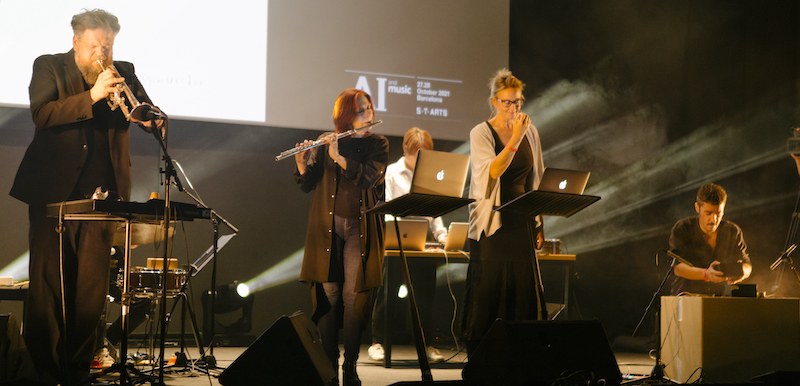
Barbara Held: flauta (2, 3)
Andrés Lewin-Richter: soporte fijo (5)
Artur Majewski: corneta y electrónica (1, 3)
Ilona Schneider: voz (2, 3)
Vasco Trilla: percusión (3, 5)
Reiko Yamada: sintetizadores analógicos (1, 3), soporte fijo (1, 6), partituras gráficas (1,2,3)

ingeniero de grabación: Ángel Faraldo
mezclado por Artur Majewski y Ángel Faraldo
masterizado por Sebastián García Ferro

Agradecimientos: Samuele Grandi, Albert Aloy, Luca Barbiero, Gorka Muñoz-Gil i Antoine Reserbat-Plantey

Interpreting Quantum Randomness al AI+Music Festival. Foto: Alba Rupérez.


Descripción de las pistas

1) Majewski, Yamada: Rabi

El tema de apertura está interpretado por Majewski en la corneta con electrónica en vivo y Yamada en los sintetizadores analógicos. La pieza tiene un soporte fijo creado a partir de datos aleatorios cuánticos. Estos datos particulares se tomaron de las emisiones espontáneas de la oscilación rabi, cuya información de intervalos de tiempo se coloca en el eje de Fourier en la síntesis de sonido, produciendo varios timbres musicales. La respuesta espontánea de Majewski y Yamada a estos datos cuánticos es el elemento central de este tema. Los datos fueron proporcionados por Samuele Grandi en el ICFO.

2) Held, Scheider: Linear transformation

La partitura de Linear transformation se generó siguiendo una secuencia de gráficos originados por Yamada a partir de este concepto matemático. Una transformación lineal es un mapeo entre dos espacios vectoriales que preserva las operaciones de suma de vectores y multiplicación escalar. Tras estudiar las partituras proporcionadas por Yamada, Held y Schneider se tomaron libertad en las expresiones creativas sin dejar de seguir fielmente la partitura. Los gestos sonoros resultantes son calculados y espontáneos al mismo tiempo, dejando los ecos misteriosos a cualquiera que escuche este tema.

3) Held, Majewski, Schneider, Trilla, Yamada: Uncertainty principle

Uncertainty principle es una improvisación colectiva en la que los músicos interpretan la notación gráfica basada en la aleatoriedad cuántica proporcionada por Yamada. Este tema está interpretado por Held a la flauta, Majewski a la corneta y la electrónica en directo, Schneider a la voz, Trilla a las percusiones múltiples y Yamada a los sintetizadores analógicos.

4) Faraldo: Un soroll més pur…

Un soroll més pur… (Un ruido más puro, en español) es una composición algorítmica abierta para caja de ritmos y objetos resonantes. Un generador de ruido cuántico proporcionado por investigadores del ICFO genera secuencias aleatorias en la caja de ritmos. El intérprete juega con estas secuencias, grabándolas, disparándolas y amplificándolas a través de diferentes objetos. Un soroll més pur… es un intento de encontrar algo de orden en el caos, creando patrones automáticos con los que nos familiarizamos a través de la repetición. De este modo, incluso el ruido más puro (el azar cuántico), se vuelve comprensible, aunque solo sea por un momento ilusorio.

5) Lewin-Richter, Trilla: ICFO

Para este tema Lewin-Richter generó una composición en soporte fijo basada en la secuencia de números aleatorios cuánticos de la oscilación Rabi, que controla varios aspectos de la estructura musical, como las envolventes y las líneas de retardo. Sobre esta banda sonora, Trilla improvisa con la percusión, alcanzando momentos de gran intensidad y sutileza por igual.

6) Faraldo, Yamada: Probability cloud

Probability cloud es una pieza creada en colaboración entre Faraldo y Yamada. Los materiales se han ido generando lentamente mediante el intercambio de sonidos en bruto entre Faraldo y Yamada, editando, procesando y añadiendo materiales adicionales a cada nueva iteración. El término ‘nube de probabilidad’ (probability cloud) se refiere a una distribución a través de una región del espacio de la probabilidad de detectar una partícula dada, como un electrón en órbita alrededor del núcleo de un átomo, determinada por la función de onda de la partícula.

Read more: Interpreting Quantum Randomness

+info